
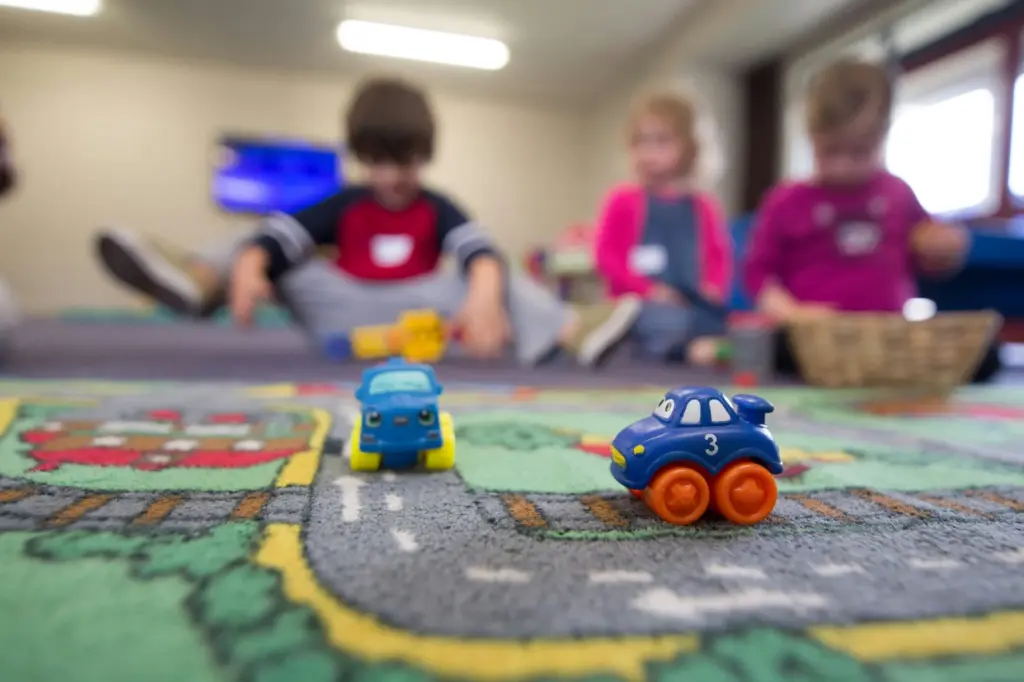
Play group is the first time most children spend two hours away from a parent in a room full of strangers their own size. What they learn there has almost nothing to do with letters and numbers, and almost everything to do with whether they can separate, ask for help, and function in a group.
The timing matters more than the curriculum. Start too early and the child spends the term distressed and learns avoidance; start too late and they arrive in nursery without the separation practice that nursery assumes. This covers what a play group does, the readiness signs worth watching for, and what to look at before enrolling.
What a Play Group Actually Is
A short, structured session for toddlers, usually two to three hours, three to five days a week. The day is built around free play, sensory activities, music and movement, story time, snack and outdoor play. Group sizes are small and adult supervision is close, since children at this age still need help with the toilet, with eating and with settling.
There is no syllabus in the school sense. The teacher’s goals are separation, basic routine, early language and the first attempts at playing near other children. Written work, worksheets and letter recognition do not belong at this stage, and their presence in a play group brochure is a useful warning sign when comparing top play schools in Bangalore.
The Right Age to Start
Most play groups in India admit children between eighteen months and two and a half years. The range is wide because readiness varies far more than age does at this stage. Two children born in the same month can be six months apart in their ability to separate from a parent.
Signs a child is likely ready:
- Can stay comfortably with a familiar adult other than the primary caregiver for an hour or more
- Walks steadily and can manage stairs with support
- Uses some words or consistent gestures to ask for what they want
- Shows interest in other children rather than only in adults
- Can be comforted by someone other than the parent when upset
- Has a reasonably predictable sleep and meal routine
Toilet training is usually not a prerequisite for play group, though it often is for nursery. Confirm this with the school rather than assuming, since policies differ.
Play Group, Nursery and Kindergarten Compared
The four stages run consecutively and the vocabulary is used loosely across schools, which causes a good deal of confusion at admission time.
|
Stage |
Typical age |
Main focus |
Typical duration |
|---|---|---|---|
|
Play group |
1.5 to 2.5 years |
Separation, routine, sensory play, early words |
2 to 3 hours |
|
Nursery |
3 years |
Group activity, self-help skills, pre-literacy |
3 to 4 hours |
|
LKG |
4 years |
Letter and number recognition, fine motor work |
4 hours |
|
UKG |
5 years |
Early reading and writing, school readiness |
4 to 5 hours |
Under the NEP 2020, Class 1 entry is set at age six, and states have been aligning their cut-off dates to it. Since the cut-off determines how the years above line up, confirm the current date with the school directly before planning backwards from Class 1.
What a Child Actually Gains
Separation and Independence
The first and most important gain. A child who has separated successfully from a parent a hundred times has learned, at a level below language, that the parent comes back. This is what makes the nursery transition manageable a year later. Children who skip play group often spend the first month of nursery working through the same separation process while also being expected to follow a longer, more structured day.
Language
Vocabulary expands rapidly between eighteen months and three years, and exposure drives it. A play group adds a second adult voice, a room full of other children talking, songs, rhymes and stories to a child’s daily input. For children in households where the home language differs from the school language, this early overlap makes the later switch considerably easier.
Motor Skills
Climbing frames, sand and water play, clay, tearing paper, threading large beads, scribbling with thick crayons. These build the hand strength and coordination that writing later depends on. A child who has spent two years squeezing, tearing and climbing arrives at pencil work with the physical capacity for it, which is the part that cannot be shortcut.
The First Social Rules
Two year olds do not share, and expecting them to is unrealistic. What they do start to absorb is the existence of rules: everyone sits for snack, toys go back in the basket, you wait while someone else has a turn. The understanding comes much later than the compliance, and the compliance has to come first. Parents evaluating top nursery schools in Bangalore a year later will find this groundwork already assumed by the nursery curriculum.
Routine and Sleep
A fixed morning, a fixed snack time and physical activity outside the house tend to regularise sleep within a few weeks. Parents often report this as the most immediate visible change, ahead of anything academic.
Signs a Child Is Not Ready Yet
Some distress in the first two weeks is normal and usually settles. What is not normal is distress that continues unchanged past four to six weeks.
- Crying at the same intensity after a month, with no settling once the parent has left
- Refusing to eat or drink for the entire session over several weeks
- Regression in skills already established, such as returning to waking through the night
- Falling ill continuously without recovery gaps, which sometimes indicates the child is too young for group exposure
Withdrawing for a few months and starting again is a reasonable decision and not a setback. A child who starts at two and a half and settles in a week has lost nothing compared with one who started at eighteen months and struggled for a term.
What to Check Before Enrolling
- Adult to child ratio, and whether it holds through the entire session rather than only at drop-off
- Whether the same teacher stays with the group all year, since consistency of the adult matters most at this age
- How the school handles the first two weeks: staggered timings and a phased separation plan are good signs
- Safety basics: gated staircases, supervised outdoor area, sanitised toys, a sick child policy in writing
- Whether the day includes outdoor play daily, not only when the weather is convenient
- The absence of worksheets, written homework or letter drills
- How the school communicates: a daily or weekly note about eating, sleeping and mood is more useful than a monthly report
Visit during a working session rather than after hours. A quiet, empty, well-decorated room tells you nothing. Watching fifteen two year olds and two adults for twenty minutes tells you almost everything, which is why top kindergarten schools in Bangalore that are confident in their practice usually allow it.
Key Takeaways
- Play group runs from about eighteen months to two and a half years and focuses on separation, routine, language and sensory play.
- Readiness signs matter more than the child’s exact age.
- Toilet training is usually not required for play group but often is for nursery.
- Distress that has not settled after four to six weeks is a signal to pause, not to persist.
- Visit during a live session and check ratios, teacher consistency and outdoor time.
Conclusion
A play group is worth joining when the child can separate, communicate a basic need and show some interest in other children, whether that happens at eighteen months or at twenty-eight. Delaying a term costs nothing measurable. Starting before the child is ready costs a term of distress and, more importantly, teaches the child that being left somewhere is something to resist. Parents shortlisting top pre schools in Bangalore are usually better served by watching one live session than by comparing three brochures.
Frequently Asked Questions
1. What is the right age for play group in India?
Most schools admit between eighteen months and two and a half years. Readiness varies widely within that range, so the signs matter more than the number.
2. Is play group necessary before nursery?
Not compulsory. It mainly builds separation and routine, which nursery then assumes. Children who skip it usually manage, but often spend the first weeks of nursery on that adjustment.
3. Does a child need to be toilet trained for play group?
Usually not. Most play groups assist with this, while nursery admission often does require it. Confirm the specific policy with the school.
4. How long does it take a child to settle?
Commonly two to four weeks. Distress that remains unchanged past six weeks is a reason to pause and try again in a few months.
5. What is the difference between play group and day care?
Play group is a short structured session focused on early development. Day care primarily provides supervised care for longer hours, often while parents work. Some centres offer both.
6. How many hours should a play group session be?
Two to three hours is typical and sufficient at this age. Longer sessions tend to produce fatigue rather than additional learning.
7. Should a play group teach alphabets and numbers?
No. Formal letter and number work is not developmentally appropriate at this stage. Sensory play, language exposure and movement build the foundations that later literacy depends on.