
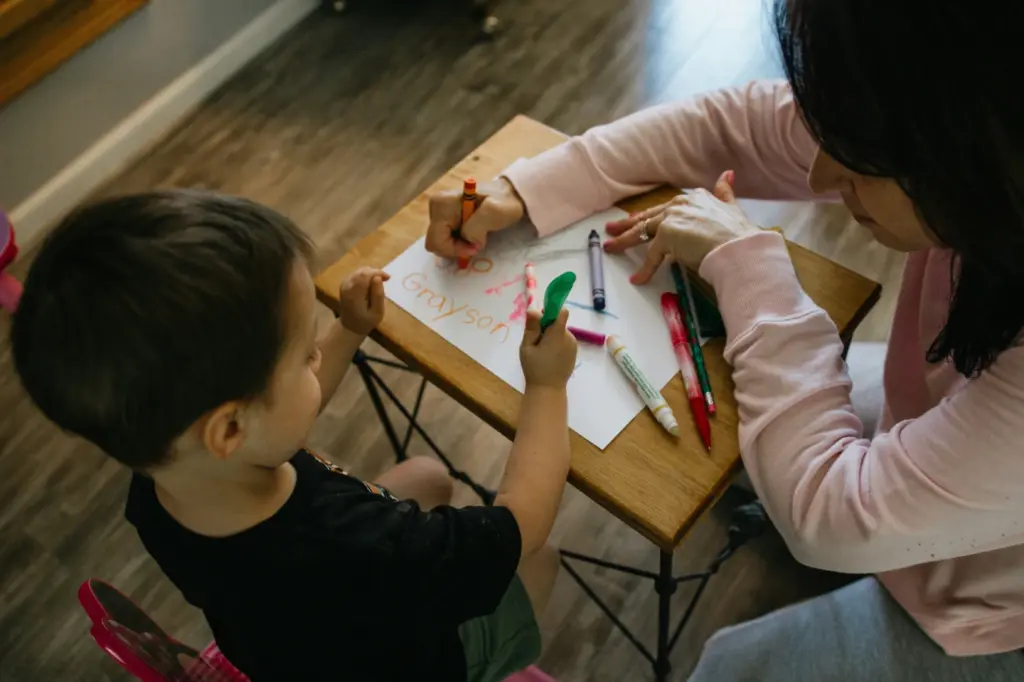
In a Class 8 classroom, the teacher explains and the student absorbs. In a preschool classroom that arrangement does not work, and trying to force it produces children who can recite the alphabet but cannot sit through a group activity or resolve an argument over a toy.
Early childhood education runs on a different division of labour. The teacher sets up conditions and observes; the child drives the actual learning through choice, repetition and failure. Understanding what each side is responsible for helps parents judge what they are seeing on a school tour, and helps them resist the instinct to measure a three year old by how much they have written.
What Early Childhood Education Covers
The National Education Policy 2020 defines a foundational stage of five years, covering ages three to eight. The first three of those years are preschool: play group, nursery and kindergarten. The National Curriculum Framework for the Foundational Stage, released in 2022, sets out what those years should achieve.
The stated goals are physical development, socio-emotional and ethical development, cognitive development, language and literacy, aesthetic and cultural development, and positive learning habits. Reading and writing appear inside language and literacy, as one strand among six, not as the purpose of the stage. That proportion is worth holding on to when comparing nursery schools in Bangalore, because a school that measures itself only on early writing is optimising for one sixth of the framework.
The Teacher’s Role
Observer Before Instructor
The first job is watching. A preschool teacher tracks which child avoids the sand tray, which one always takes the same role in pretend play, which one has stopped babbling and started forming two word phrases. Most of what happens next depends on this, because the intervention for a child who is bored and the intervention for a child who is anxious look identical from the outside and require opposite responses.
Documentation is part of this. Photographs, short written notes and work samples collected over a term give a far more accurate picture of a three year old than any single assessment, and they are what a parent meeting should be built on.
Designing the Environment
Much of the teaching happens before the children arrive. Where the reading corner sits relative to the noisy block area, whether the art materials are within a child’s reach or need an adult to fetch them, how many chairs are at the table, which toys were rotated out last week: these decisions determine what children choose to do for the next several hours.
A room set up well needs less correction during the day. A room where every activity requires adult permission produces a queue of children waiting for an adult, which is then mistaken for poor attention span.
Managing Emotions and Conflict
Three and four year olds do not yet have the language for frustration, so it arrives as hitting, snatching or crying. The teacher’s role is to name what happened, give the child the words, and stay present while the feeling passes. Removing the child from the situation solves the moment and teaches nothing.
This is the most demanding part of the job and the hardest for parents to observe on a short visit. One useful proxy is to watch how a teacher handles a minor dispute while the tour group is standing there. Rushing to separate the children is a different philosophy from crouching down and asking both of them what happened.
Partnering With Parents
A preschool teacher sees a child for four hours a day across around 200 days. The parent has every other hour. Sleep, screen time, illness, a new sibling and a change of house all show up in classroom behaviour, and none of it is visible to the teacher unless someone says so. Regular two-way communication is functional rather than ceremonial at this stage.
The Child’s Role
Choosing and Initiating
The child’s first responsibility is to choose. Free play periods exist so that a child decides what to do, for how long, and with whom. A child who is told what to do every hour of the day never builds the internal habit of starting something without instruction, and that habit is harder to install at eight than at three.
Trying, Failing and Repeating
Young children repeat obsessively: the same puzzle twenty times, the same book every night, pouring water between two cups until the floor is wet. Repetition is how the skill moves from effortful to automatic. Interrupting it to introduce something more advanced is a common and well intentioned mistake, and it is one reason the better pre schools in Bangalore build long uninterrupted blocks into the timetable rather than switching activity every fifteen minutes.
Learning to Share Space
Waiting for a turn, asking before taking, cleaning up, noticing when another child is upset. None of this is intuitive at three; all of it is learnable by five. This is the part of preschool that cannot be replicated at home with a tutor, because it requires other children of the same age who also want the same red bucket.
How the Two Roles Interact
The difference from later schooling is easiest to see side by side.
|
Aspect |
Primary and secondary classroom |
Early childhood classroom |
|---|---|---|
|
Who sets the task |
The teacher, for everyone at once |
The child, from options the teacher prepared |
|
Main teacher activity |
Explaining and assessing |
Observing, arranging, intervening selectively |
|
Pace |
Common pace across the class |
Individual, with wide variation accepted |
|
Evidence of learning |
Written work and tests |
Observation notes, work samples, photographs |
|
Response to error |
Corrected |
Often left alone so the child self-corrects |
|
Role of play |
Break from learning |
The method of learning |
Neither column is better in the abstract. The point is that applying the left hand column to a three year old produces compliance without comprehension, and applying the right hand column to a Class 9 physics lesson produces nothing at all.
What Goes Wrong When the Balance Tips
- Too much teacher direction: children wait to be told, stop initiating, and struggle with open-ended tasks later
- Too little teacher presence: the loudest children dominate the materials and conflicts go unresolved
- Early formal writing: fine motor readiness varies by more than a year at this age, and pushing a pencil too early creates avoidance rather than skill
- Over-scheduling: six activities in a morning leaves no block long enough for deep play
- Assessment pressure: a child who senses they are being graded stops taking risks, which is precisely what the stage requires
What Parents Can Look For on a School Visit
- Are teachers at the children’s eye level or standing over them?
- Is children’s own work on the walls, or printed decorations?
- Can a child reach the materials without asking an adult?
- Is there a stretch of at least forty-five minutes of uninterrupted play in the daily routine?
- How many children per adult, and does that ratio hold through the whole day or only at drop-off?
- What does the school do when two children want the same toy?
The top kindergarten schools in Bangalore tend to answer the last question with a process rather than a rule, because a process is what actually gets taught. Ask it directly; the answer separates schools faster than any brochure.
Key Takeaways
- Early childhood education has six developmental goals under the NCF Foundational Stage; literacy is one of them, not the whole.
- The teacher observes, arranges the environment, mediates conflict and works with parents.
- The child chooses, repeats, fails and learns to share space with peers.
- Play is the method of learning at this stage, not a break from it.
- On a school visit, watch the adult-child interaction and the daily routine rather than the infrastructure.
Conclusion
The clearest sign of a well run preschool is a room where the teacher is busy but not central. Children are moving between activities they chose, conflicts are being talked through rather than shut down, and the adult is crouched beside one child while quietly keeping track of the other fifteen. Parents comparing top nursery schools in Bangalore will find this more informative than any list of facilities, because it shows both roles working as they should.
Frequently Asked Questions
1. What is the main role of a preschool teacher?
To observe each child closely, design an environment that invites independent activity, help children handle emotions and conflict, and keep parents informed. Direct instruction is a small part of the job at this stage.
2. Should a three year old be writing?
Not formally. Fine motor readiness varies widely at three. Activities that build hand strength, such as tearing, threading, clay work and drawing, matter more than letter formation.
3. What does the NEP 2020 say about early childhood education?
It creates a foundational stage covering ages three to eight and treats the three preschool years as part of the school system rather than as optional preparation for it.
4. How is a preschool child assessed?
Through observation over time: teacher notes, photographs, and samples of the child’s work. Tests and grades are not appropriate at this stage.
5. What is a good teacher to child ratio in preschool?
Lower is better, and the number matters less than whether it holds through the whole day. Ask what the ratio is during free play and outdoor time, not just the headline figure.
6. Can a child learn social skills at home instead of preschool?
Partly. Turn taking and sharing need other children of the same age who want the same object at the same time, which is difficult to arrange consistently at home.
7. How much should a parent be involved?
Enough to keep the teacher informed about sleep, illness, routine changes and family events, since all of these show up in classroom behaviour and are otherwise invisible to the school.